







Voter UniversityGeorgia civics, free

Free for every Georgia voter

Learn Georgia.
Show up ready.

Plain answers about voting and government in Georgia, from how to register to who fixes the pothole on your street. Take a five-minute course, plan your vote, and earn a diploma along the way.

100% free  ·  No sign-up  ·  No ads  ·  Nonpartisan

Voter UniversityGeorgia Civics Program
Student
Standing
Incoming freshman
Credits
0 / 19
ID No.
VU-000000
Issued
—
Senate District 29

Your ID updates as you finish courses.Final exam: not taken

159counties
56state senators
180state representatives
40legislative days a year
14U.S. House seats
9Supreme Court justices
16electoral votes
Senator Randy Robertson

A note from Senator Randy Robertson

I spent more than thirty years in law enforcement here in the Columbus area. The biggest lesson I took from it is that people make good decisions when they have good information. Voting is no different.

Voter University gives every Georgian, whatever their party, the plain facts: how to register, what's on the ballot, who runs what, and where to turn when something goes wrong. It's free. It never asks how you vote. And every fact on it is checked against Georgia law.

Whether you live in Pine Mountain, Greenville, LaGrange or Columbus, I hope you'll take a course or two, pass it along to a neighbor, and show up ready.

Randy Robertson
State Senator, District 29

56 senators. 180 representatives.
40 days a year under the Gold Dome.

Here's how a bill becomes Georgia law, and where your voice fits in.

Read GOV 202: How a bill becomes law →
1

Check your registration

Confirm you're registered at your current address. My Voter Page also shows your polling place, your districts and a sample ballot.

Open My Voter Page
2

Have your photo ID

Georgia requires photo ID to vote in person. If you don't have one, a Voter ID card is free from your county registrar or any DDS office.

VOTE 102: Photo ID
3

Pick how you'll vote

Early in person, by mail or on Election Day. Each has its own dates. The plan builder lays them out for any election.

Build my voting plan
4

Study your ballot

Ballots include local races, judges and statewide questions you may not have heard about. Read your sample ballot before you go.

VOTE 104: Reading your ballot
Questions about your own record? Call your county elections office (see Local Offices) or the Secretary of State's Elections Division at 404-656-2871.

You can register in Georgia if you are a U.S. citizen, a legal resident of Georgia and of the county where you want to vote, and at least 17½ years old, as long as you'll be 18 by Election Day.

Four ways to register

Online

Use the Secretary of State's online system. You need a Georgia driver's license or state ID card.

Automatically at DDS

Georgia registers eligible voters when they get or renew a driver's license, unless they opt out.

By mail

Print the state or national form, sign it, and mail it. It counts as of its postmark date.

In person

Visit your county board of registrars' office.

The deadline: registration closes on the fifth Monday before an election. If that Monday is a legal holiday, it moves to the next business day. The same deadline applies to updating your name or address.

Keeping your registration current

Moved within your county? Update your address so you get the right ballot. Moved to a new county? Update your registration to vote there. Changed your name? Update that too. All of it can be done online with a Georgia license or ID.

There is no Election Day registration in Georgia. Check your status on My Voter Page well before the deadline.

Check my registration on My Voter Page

Bring one of these to vote in person, either early or on Election Day:

  • A Georgia driver's license, even if it's expired
  • Any valid state or federal government photo ID, including the free Georgia Voter ID card
  • A valid U.S. passport
  • A valid employee photo ID from a federal, state, county or city government agency
  • A valid U.S. military photo ID
  • A valid tribal photo ID
No ID? It's free. Any county registrar's office or Department of Driver Services office issues a Georgia Voter ID card at no cost. Bring documents that prove who you are and where you live.

Voting by mail

Your absentee application and ballot envelope ask for your Georgia driver's license or state ID number. If you have neither, you include a copy of another acceptable ID.

Forgot it at home? You can still cast a provisional ballot. It counts if you bring your ID to the county registrar within three days after the election. If there's time, going home for it and coming back is simpler.

Full ID rules from the Secretary of State · Free Voter ID at DDS

MethodWhenWhereKnow this
Early in person (advance voting)Starts the 4th Monday before the election and ends the Friday before. Required on weekdays and on the 2nd and 3rd Saturdays before. Sundays are optional by county.Any early voting site in your countyNo excuse needed. Same photo ID rules as Election Day.
By mail (absentee)Request between 78 and 11 days before the election. Your ballot must be received by 7 p.m. on Election Day.Return by mail, at a drop box inside an early voting site during voting hours, or at your county registrar's officeNo excuse needed. Voters 65+, voters with disabilities, and military and overseas voters can request ballots for the whole election cycle.
Election DayPolls open 7 a.m. to 7 p.m. If you're in line by 7 p.m., you get to vote.Only your assigned precinctCheck your polling place on My Voter Page. It can change between elections.
A rural polling place in Pavo, Georgia
A rural polling place in Pavo, Georgia · Michael Rivera, CC BY-SA 3.0
Wrong precinct on Election Day? Before 5 p.m., poll workers will direct you to your correct precinct. After 5 p.m., you may cast a provisional ballot there, and the races you're eligible for are counted.

Track your mail ballot on My Voter Page from request to acceptance. Military and overseas voters: a ballot postmarked by Election Day counts if it arrives within three days.

Build your voting plan to see the exact dates for any election.

Most voters know the top of the ticket. The rest of the ballot is where people get surprised. Here's what can show up, depending on the year and where you live:

Federal

  • President (every 4 years)
  • U.S. Senate (6-year terms, staggered)
  • U.S. House (every 2 years)

State

  • Governor and 7 other statewide officers
  • Public Service Commission
  • State Senate and House (every 2 years)
  • Supreme Court and Court of Appeals

Local

  • County commission, sheriff, judges
  • School board
  • Mayor and city council
  • Local tax and bond questions

Nonpartisan races

Judicial races, and some local races, list no party next to the names. Look up candidates ahead of time.

Constitutional amendments

Changes to the Georgia Constitution need voter approval. You'll see a short summary and vote Yes or No.

Referendum questions

Statewide or local questions, like a local sales tax for projects. Read the full wording on your sample ballot.

You can skip a race

Leaving a contest blank doesn't spoil the rest of your ballot. Every other vote still counts.

Homework before Election Day: pull your sample ballot from My Voter Page, look up anything you don't recognize, and bring notes. Try the Practice Ballot Lab, and read the 2026 amendments explained.

Primaries choose each party's nominee. Georgians don't register by party. At a primary you choose a Democratic, Republican or nonpartisan ballot. Nonpartisan races, like many judicial seats, appear on every ballot.

Runoffs are Georgia's tiebreaker. To win, a candidate needs a majority: 50% plus one vote. If nobody gets there, the top two face off again. That applies to primaries and to the November general election.

Two runoff rules people miss:
1. You can vote in a runoff even if you skipped the first round, as long as you were registered in time.
2. If you voted in one party's primary, you stay with that party in the primary runoff.

A general election runoff is held four weeks (28 days) after the general election. Early voting for a runoff starts as soon as possible, so the window is short. Plan ahead.

The polls close at 7 p.m., but an election isn't over until the results are certified. Here's what happens next:

  1. Election night counts are unofficial. Counties report results as they're tallied. "100% of precincts reporting" doesn't mean every ballot is counted.
  2. Late ballots get added. Provisional ballots can be fixed until three days after the election. Military and overseas ballots postmarked by Election Day count if they arrive within three days.
  3. Counties certify. Georgia law requires each county to certify its results by 5 p.m. on the Monday after the election. Georgia courts have ruled this is a required duty, not an optional vote.
  4. The state audits. Teams hand-count random batches of paper ballots to confirm the machine count.
  5. The Secretary of State certifies the statewide results.
Recounts: when the margin in a race is 0.5% or less, the trailing candidate can request a recount after certification. Recounts rescan the paper ballots.

The only official winner is the one in the certified results. News outlets "call" races based on projections, which is not the same thing.

Legislative

The General Assembly writes laws and passes the budget. Senate: 56 members. House: 180 members. Both serve 2-year terms with no term limits.

Executive

The Governor carries out the law, proposes the budget and signs or vetoes bills. Eight statewide officers are elected separately.

Judicial

Courts interpret the law. The Supreme Court has 9 justices; the Court of Appeals has 15 judges. Both are elected in nonpartisan races to 6-year terms.

The Georgia Senate chamber, where 56 senators meet
The Georgia Senate chamber, where 56 senators meet · DXR, CC BY-SA 4.0
The Georgia House chamber, home to 180 representatives
The Georgia House chamber, home to 180 representatives · DXR, CC BY-SA 4.0

The statewide officers you elect

OfficeWhat it handles
GovernorHead of the executive branch; signs or vetoes bills, with a line-item veto on spending
Lieutenant GovernorPresides over the State Senate; elected separately from the Governor
Secretary of StateChief election officer for Georgia; counties run the actual elections
Attorney GeneralThe state's lawyer; includes consumer protection
State School SuperintendentOversees statewide education programs and state school funding
Commissioner of AgricultureFarming, food safety and related inspections
Commissioner of InsuranceRegulates Georgia's insurance industry
Commissioner of LaborRuns unemployment insurance and job services
Public Service Commission (5 members)Regulates rates and service for certain utilities: electric, natural gas and telecommunications

Below the appellate courts are superior courts in 49 judicial circuits, plus state, probate, magistrate and juvenile courts. Every county has a probate court, which handles wills, estates, guardianships and marriage licenses.

The General Assembly meets every year starting on the second Monday in January, for no more than 40 legislative days. Those days aren't consecutive, so session usually runs into late March or early April. The final day is called Sine Die.

IdeaA citizen, group or legislator brings an idea to a lawmaker.
FiledOnly a legislator can introduce a bill. Tax and spending bills start in the House.
CommitteeA committee holds hearings, amends it, and votes.
Floor voteThe full chamber debates and votes.
Other chamberSame process. Both chambers must pass identical text.
GovernorSigns, vetoes, or lets it become law without a signature.
The gold dome of the Georgia State Capitol, which gives the legislature its nickname
The gold dome of the Georgia State Capitol, which gives the legislature its nickname · connor.carey, CC BY-SA 3.0
The Governor's clock: 6 days to act while the legislature is in session, or 40 days after Sine Die. A bill the Governor doesn't act on becomes law. The legislature can override a veto with a two-thirds vote in both chambers.

Most new laws take effect July 1. The legislature works in two-year terms; a bill that hasn't passed by the end of the second year dies and must be filed again.

Track any bill at legis.ga.gov. Want to weigh in? See CIV 306: Make your voice heard.

Georgia has 159 counties, more than any state except Texas. Local governments decide many things that touch your day most directly: roads, policing, schools, zoning and property taxes.

County commission

Sets the county budget and local ordinances. A few counties use a single "sole commissioner" instead of a board.

Sheriff

Runs the county jail, serves warrants and provides court security; also patrols in many counties.

Tax commissioner

Collects property taxes and handles vehicle tags. Property values are set by the county tax assessors.

Clerk of Superior Court

Keeps court records, real estate records and more.

Probate judge

Wills, estates, guardianships, marriage licenses and weapons carry licenses.

Board of education

Elected locally; hires the superintendent and sets the school budget.

The Government Center of Columbus Consolidated Government
The Government Center of Columbus Consolidated Government · Gary Dunn, CC BY-SA 3.0
Local spotlight: Columbus and Muscogee County merged on January 1, 1971, forming Georgia's first consolidated city-county government. One government now serves the whole county.

City elections are usually held in odd-numbered years. They often have low turnout, so each vote carries more weight.

Every Georgian has many layers of elected representation. Your exact districts depend on your address, and My Voter Page lists them.

SeatHow manyTerm
U.S. Senators2, statewide6 years
U.S. Representative14 districts2 years
State Senator56 districts2 years
State Representative180 districts2 years
Public Service Commissioner5 districts, elected statewide6 years
Governor and statewide officers8 offices4 years
County commissioner, school board, city councilVaries by county and cityUsually 4 years
Senate District 29 covers all of Harris and Meriwether counties and parts of Muscogee and Troup counties. Confirm your own districts on My Voter Page.

Every year the General Assembly passes two budgets: an amended budget that adjusts the current year, and a full budget for the next fiscal year, which runs July 1 to June 30.

Revenue estimateThe Governor sets how much money the state expects to collect.
ProposalThe Governor presents a budget in January.
House firstSpending bills must start in the House.
SenateThe Senate makes its own changes.
Final dealBoth chambers agree on one version.
SignatureThe Governor signs it and can strike line items.
Balanced by rule: the legislature can't spend more than the Governor's revenue estimate, so Georgia's budget must balance every year. The Governor's line-item veto lets him strike individual spending items without vetoing the whole budget.

Where the money goes

In the Governor's Fiscal Year 2027 proposal, education took the largest share of state funds, at about 54%. Health came next at about 24%, then public safety and transportation at roughly 7–8% each. Georgia also keeps a rainy-day fund, the Revenue Shortfall Reserve, which state law caps at 15% of the previous year's revenue.

Governor Kemp signed the FY 2027 budget on May 12, 2026, using his line-item veto to cut about $300 million in new spending the legislature had added.

Read the budget at the Office of Planning and Budget

Georgia's current constitution is its tenth. Voters ratified it on November 2, 1982, and it took effect July 1, 1983. It has 11 articles and has been amended many times since.

How an amendment gets to your ballot

ResolutionA legislator files a resolution proposing the change.
Two-thirdsAt least 120 of 180 House members must vote yes.
Two-thirdsAt least 38 of 56 senators must vote yes.
No signatureThe Governor doesn't sign or veto amendments.
BallotIt goes to voters at the next general election.
MajorityOver 50% yes and it becomes part of the constitution.
No citizen petitions: Georgians can't put a statewide measure on the ballot by gathering signatures. Every statewide amendment starts in the legislature. That's why the questions on your ballot matter. They're your one direct vote on the state's founding document.

The legislature can also send voters a statewide referendum, a question about a law rather than the constitution. These need only a simple majority in each chamber and the Governor's signature to reach the ballot.

See the three 2026 amendments, explained.

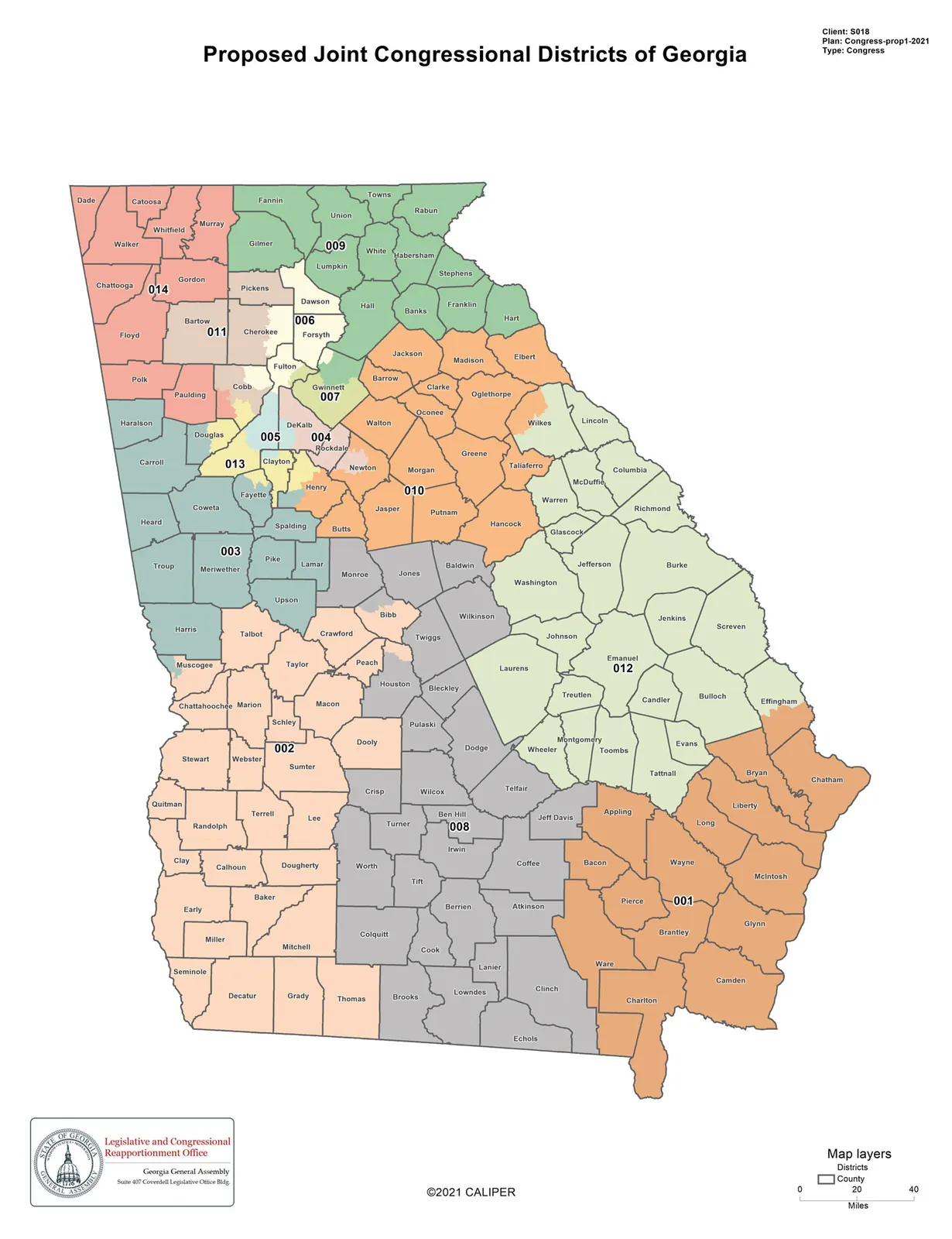
Every 10 years, the U.S. Census counts everyone. Districts are then redrawn so each one holds about the same number of people. In Georgia, the General Assembly draws the lines for its own 56 Senate and 180 House districts and for the state's U.S. House districts.

Who draws

The legislature passes the maps as bills. The Governor can sign or veto them.

The rules

The Georgia Constitution requires districts made of connected territory. Federal law requires equal population and protects voters from discrimination.

Public input

Committees hold public hearings during redistricting. Residents and groups can comment and submit their own maps.

Why it matters

District lines decide which candidates appear on your ballot, and which neighbors share your representatives.

A proposed U.S. House map from Georgia's 2021 redistricting. Lines have changed since, so check My Voter Page for yours
A proposed U.S. House map from Georgia's 2021 redistricting. Lines have changed since, so check My Voter Page for yours · Georgia General Assembly, public domain
Lines change. After any redistricting, check My Voter Page. Your districts, and even your polling place, may be different.
  1. A paper ballot for every vote. At the polls you make your picks on a touchscreen, which prints a paper ballot. You check the paper, then feed it into a scanner that drops it into a locked box.
  2. Check-in with photo ID confirms each voter is who they say they are, and voter records show if someone already voted.
  3. Poll workers and observers watch the process at each step.
  4. Audits before certification. Since 2019, Georgia law has required a risk-limiting audit after elections. Teams hand-count randomly chosen batches of paper ballots and compare them with the machine count. Lawmakers have expanded audit requirements since then.
  5. Counties run elections; the state oversees. County officials count and certify locally, then the Secretary of State certifies statewide.
Why paper matters: if anyone questions a result, election officials can go back to the paper ballots voters checked themselves.

False claims about voting spread fastest right before an election. They usually target the logistics: a "new" deadline, a changed polling place, or a claim that you can vote by text. Use this test before you share:

1. Who said it?

Official election information comes from the Secretary of State, Georgia.gov or your county elections office. A screenshot isn't a source.

2. Does it change a rule?

Deadlines and voting methods are set by law. A post claiming the rules suddenly changed needs checking first.

3. Is it trying to rush you?

"Share before it's deleted!" is a red flag. Real election notices aren't secret.

4. Check it yourself

Look up your own registration, polling place and ballot status on My Voter Page in under a minute.

You can't vote by text, phone call or email in Georgia. Anyone telling you otherwise is wrong. Report problems through the Secretary of State's website or your county elections office.
  • In line by 7 p.m.? You get to vote, even if it's past closing.
  • Name not on the list, or no ID? Ask for a provisional ballot. Fix the issue with your county registrar within three days after the election and it counts.
  • Need help? Polling places offer accessible voting equipment, including audio ballots. Contact your county registrar ahead of time about any special assistance.
  • Time off work. Your employer must let you take up to two hours off to vote, with reasonable notice. That covers early voting days and Election Day. Your employer can choose when you take it, and it can be unpaid.
  • A private ballot. Nobody can require you to show how you voted.
Something go wrong? Ask the poll manager first. Then contact your county elections office, or submit a complaint through the Secretary of State's website.

College students

Register at home or at school, whichever you consider your residence, but not both. Away from your home county? Request an absentee ballot early.

Military and overseas

You can request ballots for the whole election cycle. A ballot postmarked by Election Day counts if it arrives within three days.

Voters 65+ and voters with disabilities

One absentee application can cover the whole election cycle. Accessible equipment is available at every polling place.

Just turned 17½

You can register now if you'll be 18 by Election Day.

Moved or changed your name

Update your registration by the deadline, the fifth Monday before the election.

A past felony conviction

Your right to vote returns automatically once your whole sentence is complete, including probation, parole and fines. You do need to re-register. If you're serving a First Offender sentence that hasn't been revoked, you can still vote.

Hospitalized close to Election Day? Georgia offers emergency absentee ballots. Call your county elections office.

Elections are run by neighbors. Every early voting site and polling place depends on trained poll workers, and counties hire them for every election. It's paid work.

Who can serve

  • A U.S. citizen, at least 16 years old. High school students can serve.
  • A resident or employee of the county where you'll work
  • Able to read, write and speak English
  • No felony conviction, unless your rights have been restored
  • Not a close relative of a candidate on the ballot where you're working

What you'll do

Check in voters, hand out ballot cards, help voters use the equipment, and close the polls.

Training first

Your county trains you before each election. Pay varies by county and position, so ask when you apply.

Sign up: contact your county elections office. In Muscogee County, email MuscogeePollWorkers@columbusga.gov.

Poll workers are hired and paid by the county. Poll watchers are different: they're appointed by parties or candidates to observe.

Voting is the start. Between elections, these are the ways ordinary Georgians shape what government does:

Contact your legislators

Find your state senator and representative on My Voter Page. A short, specific email or call about one bill works best. Say you're a constituent and where you live.

Testify at a hearing

Legislative committees take public testimony on bills. Watch committee schedules on legis.ga.gov during session.

Speak at local meetings

County commissions, city councils and school boards hold public meetings, usually with time for public comment.

Request public records

Georgia's Open Records Act lets anyone request most government records. Its Open Meetings Act keeps most government meetings open to the public.

Serve on a board

Counties and cities appoint residents to boards like planning, zoning and library boards.

Run for office

Many local seats draw few candidates. Your county elections office can explain qualifying dates and fees.

Best timing: lawmakers file most bills before and early in session, which starts the second Monday in January. Reach out in the fall, before the rush.

Key dates

Dates from Georgia.gov and county election offices. Polls open 7 a.m. to 7 p.m. on Election Day and on runoff day.

What's on the ballot

Federal

  • One U.S. Senate seat
  • All 14 U.S. House seats

State

  • Governor and Lieutenant Governor
  • Secretary of State, Attorney General, School Superintendent and other statewide offices
  • Every seat in the Georgia Senate and House
  • Nonpartisan Supreme Court and appellate judges

Local

  • Races and questions vary by county
  • Check your sample ballot for local races and measures

We don't list candidates here. Your sample ballot on My Voter Page shows every name you'll see, exactly as it will appear.

The three constitutional amendments

These are at the bottom of every Georgia ballot. Each one was placed there by a two-thirds vote of both chambers of the legislature. Each needs a simple majority of voters to pass.

Amendment 1 · Farmland conservation use

Raise the cap on farm and timber land that can be taxed at its farming value, from 2,000 to 4,000 acres per owner?

As it appears on your ballot

Shall the Constitution of Georgia, for the purpose of protecting family farmland, be amended so as to increase the maximum acreage to qualify for assessment and taxation as a bona fide conservation use property from 2,000 acres to 4,000 acres?

If YES winsOwners of farm and timber land could enroll up to 4,000 acres in the conservation-use program, which taxes land at its farming value instead of its market value.
If NO winsThe limit stays at 2,000 acres per owner.


Amendment 2 · Probate judge elections

Require every county's probate judge to be elected without a party label?

As it appears on your ballot

Shall the Constitution of Georgia be amended so as to require that all probate court judges be elected in nonpartisan elections?

If YES winsProbate judges would run without a party next to their name, the way Supreme Court justices do.
If NO winsNonpartisan elections would not be required for probate judges.

Amendment 3 · 9-1-1 systems fund

Let the legislature set aside existing money in a protected fund used only for 9-1-1 systems?

As it appears on your ballot

Shall the Constitution of Georgia be amended so as to authorize the General Assembly to dedicate certain existing revenues, including revenues reallocated by law, to a nonlapsing fund to be used exclusively for the expansion, maintenance, and operation of emergency 9-1-1 systems in this state?

If YES winsThe legislature could put existing revenue into a protected fund used only for 9-1-1, including next-generation upgrades for cellphone location, texts and video.
If NO winsThe legislature would not gain this authority to create a dedicated 9-1-1 fund.

Ballot wording from the official text. Read the full amendments and official summaries from the Secretary of State. Want the background? Take GOV 206: Georgia's Constitution.

After Election Day

Results are unofficial at first

Counties must certify by 5 p.m. the Monday after the election. Then the state audits and certifies. See VOTE 106.

Runoff on Dec. 1, if needed

Any race without a majority winner goes to a runoff between the top two. Registration for the runoff closed Nov. 2. Early voting starts as soon as possible, so check your county.

Starts on the next November general election. Change it for a primary, runoff or special election.

    Dates are calculated from Georgia's election code, including the rule that early voting and the registration deadline skip state holidays. Always confirm on My Voter Page or with your county elections office.

    Nonpartisan · Vote for one

    Mayor of Peach Hollow (practice)

    Proposed constitutional amendment · Practice

    Amendment 1: Shall the Constitution be amended to name the brown thrasher the official mascot of state parks?

    1. 1Make your picks on the touchscreen. Skip any contest you like.
    2. 2Print your paper ballot.
    3. 3Read the paper. Make sure every choice is right. If not, ask a poll worker for a new one.
    4. 4Scan it. The scanner reads your paper ballot and keeps it for audits.
    Your address goes only to the U.S. Census Bureau's free address lookup. We don't store it.
    Loading the map…

    Statewide and national

    These officials serve every Georgian, no matter which district you live in.

    Secretary of State, Elections Division

    For questions your county can't answer, or to file a complaint.

    404-656-2871

    sos.ga.gov

    Senate District 29

    District 29 covers all of Harris and Meriwether counties and parts of Muscogee and Troup counties in West Georgia. Your state senator serves a two-year term and votes on every state law and the state budget.

    Find all my districts

    Not in District 29? Every county in Georgia has an elections office. My Voter Page lists yours.

    Past issues

    1777Georgia creates its first eight counties: Burke, Camden, Chatham, Effingham, Glynn, Liberty, Richmond and Wilkes.
    1896Georgians begin electing Supreme Court justices by popular vote.
    1943Georgia becomes the first state to lower its voting age from 21 to 18, decades before the rest of the nation.
    1945Georgia repeals its poll tax. A new constitution caps the state at 159 counties.
    1971Columbus and Muscogee County form Georgia's first consolidated city-county government.
    1983Georgia's tenth and current constitution takes effect on July 1.
    2019State law begins requiring post-election audits of paper ballots.
    2020Georgia's paper-ballot voting system is used statewide for the first time.
    The U.S. Post Office and Courthouse in Columbus, 1934
    The U.S. Post Office and Courthouse in Columbus, 1934 · U.S. government photo, public domain

    Columbus, before consolidation

    Decades before Columbus and Muscogee County merged in 1971, the city and the county ran separate governments. Today one consolidated government serves the whole county.

    The monthly comic

    One Georgia issue each month, with the facts on both sides and a few questions to help you decide where you stand.

    Read this month's comic

    Georgia's runoff rule

    Georgia is one of only a few states that holds runoffs after the general election, not just after primaries. A candidate needs more than half the vote to win outright.

    Take VOTE 105
    Voter University
    Voter University

    hereby confers upon

    A Georgia Voter
    Bachelor of Ballots · Georgia Civics

    Take a screenshot to share it.